
This Washington Needs More Canada
The Growing Number of Scholars Working on Canada Is a Sign of Strength, Not Fragmentation

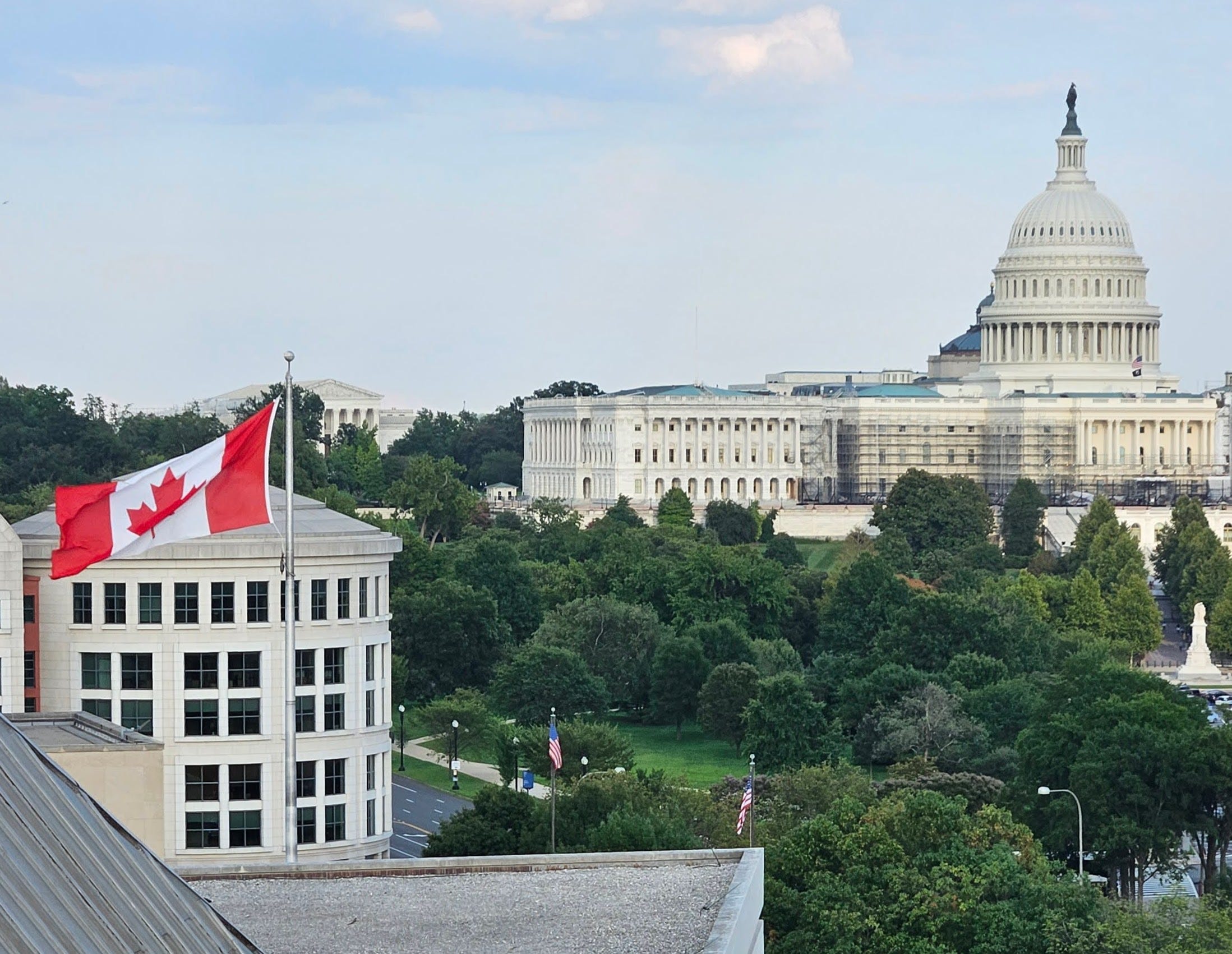
A happy new year began with the news—announced on LinkedIn—that Canadian business executive and political strategist Goran Pesic is establishing a new United States–Canada Institute in Washington, DC. Details have yet to emerge, particularly regarding staffing and programmatic focus. Still, any initiative devoted to understanding and improving the bilateral relationship is a welcome addition to the Washington policy ecosystem.
This is not the first recent expansion of analytical capacity on U.S.–Canada issues in the capital. Two years ago, the Macdonald-Laurier Institute launched the Washington-based Center for North American Prosperity and Security (CNAPS). Under the leadership of Jamie Tronnes, what began as a partnership with the Hudson Institute has grown into a broader platform engaging policymakers, analysts, and advocates across Washington.
A Longstanding—and Expanding—Policy Community
My own professional path has intersected with many of the institutions that have shaped U.S.–Canada policy debates over several decades. Earlier in my career, I was a senior fellow at the Hudson Institute, a U.S. think tank founded by the late Herman Kahn that maintained an office in Montreal from 1974 to 1994 and took pride in its Canadian work. That legacy included a 1979 study on the development potential of Alberta’s oil sands—research that later earned an entire chapter of criticism in Andrew Nikiforuk’s Tar Sands: Dirty Oil and the Future of a Continent.
Hudson today remains home to an impressive group of scholars whose work touches directly on Canada and North America, including Matthew Boyse, Jack David, and Brigham McCown. Former Conservative Party of Canada leader Erin O’Toole also serves as a Distinguished Fellow there, reinforcing Hudson’s role as a venue for serious cross-border dialogue.
Before Hudson, I spent many rewarding years at the Center for Strategic and International Studies (CSIS), working in the Americas Program and leading what was then known as the Canada Project from 1992 to 2006. Alongside an outstanding group of affiliated scholars, we examined the impact of free trade and, later, the consequences of the September 11, 2001, terrorist attacks on the United States and its closest partner.
After I left CSIS, work on Canada continued through its deep bench of scholars focused on trade, energy, and international security. Today, Ryan Berg and Christopher Hernandez-Roy—himself a proud Canadian—carry that work forward. CSIS research on the United States–Mexico–Canada Agreement, critical minerals strategy (led by Gracelin Baskaran), border security, pandemic coordination, military procurement reform, and Canada’s global role remains among the most rigorous in Washington.
The Brookings Institution also has a long and distinguished record of engagement on Canadian issues. From Kent Weaver’s work on Canadian federalism and Quebec separatism in the 1990s, to John Austin’s research on the Great Lakes regional economy, to Howard Wial’s leadership on automotive industrial policy during the 2008–2009 financial crisis, Brookings has repeatedly returned to Canada at moments of strategic consequence.
While I was at Hudson, Brookings commissioned me to study U.S.–Canada border security in 2008 and 2009. More recently, the Brookings-led USMCA Initiative under Brahima Coulibaly and Joshua Meltzer has produced annual assessments of the agreement and the North American economy—analyses proving invaluable as governments undertake the mandated 2026 review.
Another important contributor is the Center for a New American Security (CNAS). CNAS has developed a growing body of research on U.S. economic security and the strategic value of deeper integration with Canada and Mexico. Led by Emily Kilcrease and Geoffrey Gertz, both former National Security Council staffers, the project has drawn an impressive network of collaborators across Washington.
Canada’s Presence Across Washington’s Think Tank Landscape
Beyond these institutions, many Washington think tanks engage with U.S.–Canada relations on a regular or episodic basis. At the American Enterprise Institute, Karlyn Bowman and Canadian scholar Colin Dueck have produced influential work on public opinion and U.S. foreign policy, respectively, at an institution long associated with Canadian commentator David Frum. At the Heritage Foundation, James Carafano and Andrew Hale have written on Canadian defense and politics. Richard Sanders, a former foreign service officer previously affiliated with the Wilson Center, now serves as a senior fellow at the Center for the National Interest, where he continues to write incisively on Canadian affairs.
Policy engagement on Canada also thrives where there is no formal Canada-focused unit. The Bipartisan Policy Center has built a strong record on immigration and visa policy, led for many years by Theresa Brown, a former head of the U.S. Department of Homeland Security’s Canada Desk and the first DHS liaison officer posted to Ottawa. The Migration Policy Institute has produced essential research by Muzaffar Chishti, Julia Gelatt, and Andrew Selee on refugee flows at Roxham Road, visa policy, and immigrant integration.
The Atlantic Council has expanded its work on Arctic and energy security with explicit attention to Canada, while Oren Cass at the America First Institute has engaged Canada within debates over economic nationalism and the intellectual currents shaping the Make America Great Again movement.
Trade, Economics, and North America’s Strategic Core
Trade and economic relations with Canada are inevitably on the agenda of institutions focused on the United States’ role in the world. At the Council on Foreign Relations, Edward Alden and now Inu Manak—both Canadians—have done outstanding work on U.S. trade policy. At the Peterson Institute for International Economics, Gary Hufbauer and Jeffrey Schott have been central figures in North American trade debates since the days of the original U.S.–Canada Free Trade Agreement.
There are two additional channels through which Canada-related policy research consistently enters Washington debates: business organizations and structured, recurring engagement by regional and professional groups.
The most prominent business voice on U.S.–Canada relations remains the Canadian American Business Council, led for many years by Maryscott “Scotty” Greenwood and now by Beth Burke. The Business Council of Canada has established a Washington office and expanded its engagement on trade and economic policy. The Canadian Chamber of Commerce has revived its collaboration with the U.S. Chamber and jointly organized business delegations to the capital.
The North American Strategy for Competitiveness Organization (NASCO) regularly engages all three federal capitals, bringing perspectives from the continent’s heartlands on infrastructure, regulation, and competitiveness. Laura Dawson, former director of the Wilson Center’s Canada Institute, now brings the Future Borders Coalition she leads to Washington on a regular basis.
Legal and regional networks also play a vital role. The Canada–U.S. Law Institute, jointly sponsored by Case Western Reserve University and Western University in Ontario, convenes an annual Experts Meeting in Washington on issues ranging from trade to artificial intelligence regulation, critical minerals, and sanctions coordination. The Pacific NorthWest Economic Region (PNWER), headquartered in Seattle, unites state and provincial governments from Alaska to Alberta and the Yukon to Oregon, engaging business and civil society actors on energy transition, Arctic development, and regional integration.
What Was Lost with the Canada Institute
Against this broad and diverse landscape, the closure of the Wilson Center’s Canada Institute in March 2025 was a loss felt across Washington’s scholarly community. I served as the Institute’s final director, and it played a distinctive role as a nonpartisan hub dedicated to Canada, the bilateral relationship, and North American political economy. Its work was strengthened by the Wilson Center’s Mexico Institute and Polar Institute, which provided depth and reach to our analysis.
While Canada-focused expertise in Washington remains substantial, it is now more widely dispersed—and perhaps less visible—than when the Canada Institute served as a convening focal point.
My view is straightforward: the more points of engagement on U.S.–Canada relations in Washington, the better. The intellectual capacity already exists to diagnose problems and propose solutions across a wide range of issues. I hope, in the weeks ahead, to add to that capacity through a rebooted center at Johns Hopkins University’s School of Advanced International Studies—an academic platform connecting Canadian scholars with Washington, engaging the next generation of American and Canadian leaders, and drawing on historical experience to inform contemporary challenges.
The Missing Ingredient: American Engagement
The most critical missing ingredient remains robust U.S. engagement. Too many Americans have been silent or complacent during the recent strain in the relationship with Canada. There are now numerous entry points into Washington policy debates—including the newest initiative announced yesterday. With so much intellectual kindling at hand, my hope is that we can spark renewed attention and make 2026 the year the United States and Canada actively work together to renew and strengthen their partnership.